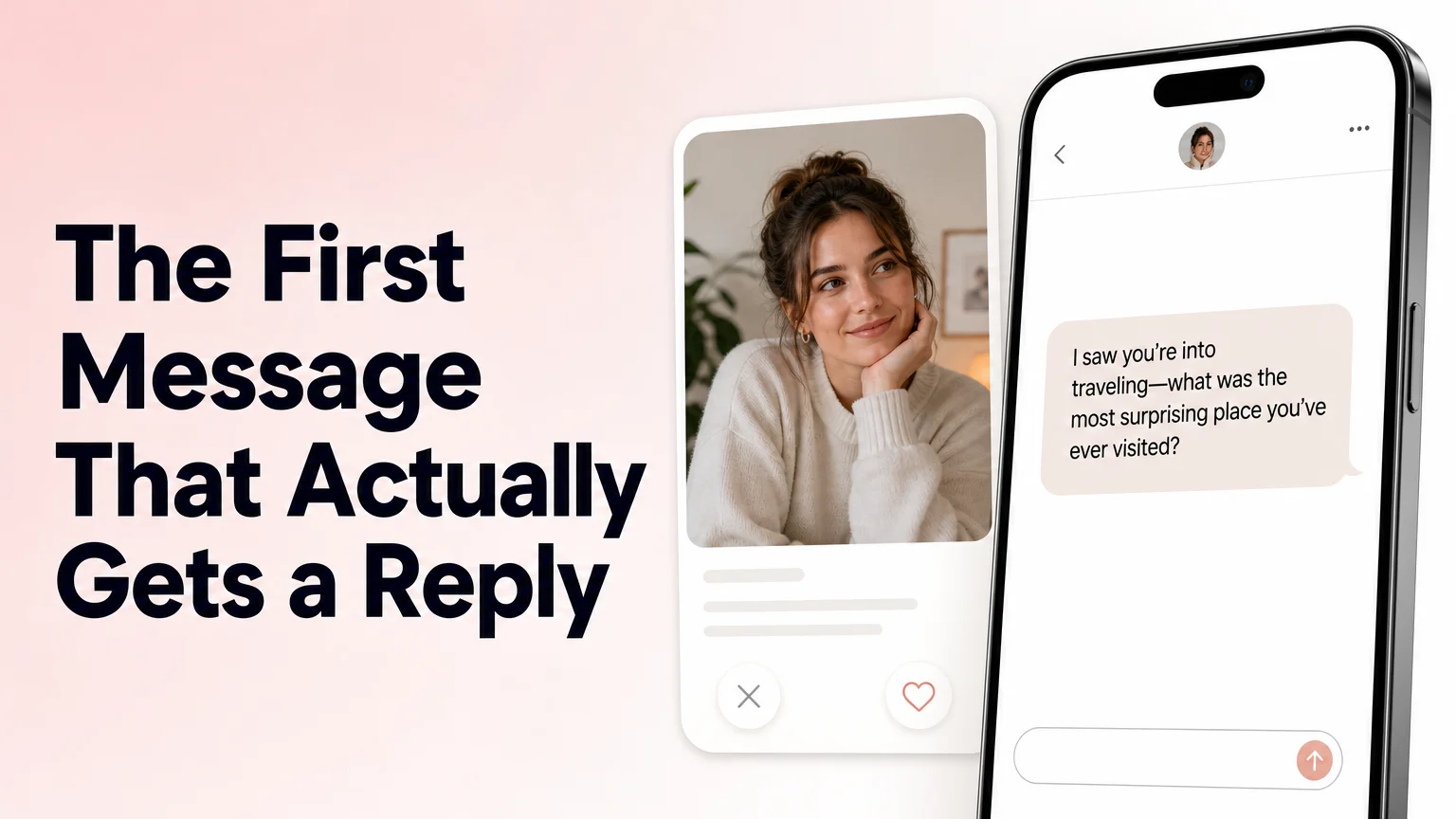
First Message on a Dating App: What Works
First Message on Dating App: What the Data Actually Shows
A specific first message on dating app profiles is roughly three times more likely to get a reply than a generic one — and most guys still open with "hey" anyway. Getting the first message right doesn't take more effort. It takes a different kind of attention: read what's actually on the profile, then write two sentences that only make sense as a reply to that person.
Key Takeaways
- A specific first message that references her profile is roughly 3x more likely to get a reply than a generic "hey"
- The right tone — Witty for Hinge, Sincere for something vulnerable, Bold when you want to be direct — sets the conversation's momentum from the first line
- Personalization means reading what's actually on the profile, not filling in a name and a compliment
- A copy-paste line is fine if it's already specific and complete — placeholder templates are the actual problem
- Most first messages die because the sender played it safe, not because the match said no
What Is the Best First Message on Dating App Profiles?
The best first message on dating app profiles references one specific, real detail from her profile and turns it into a line worth responding to. It skips "hey," skips the generic compliment, and proves in one sentence that you read the profile instead of just swiping past the photos.
That's it. Not clever, not complicated — just specific. The gap between a message that gets ignored and one that gets a reply almost always comes down to whether the sender used anything unique to that person's profile.
| Approach | Example Line | Typical Outcome |
|---|---|---|
| Generic opener | "Hey, how's it going?" | Ignored, or a one-word reply |
| Compliment-only | "You're gorgeous" | Reads as low effort, often skipped |
| Specific + reaction | "Your marathon prompt reads like a flex disguised as small talk. Which mile broke you?" | Prompts an actual answer |
By the numbers: 720 people search "first message on dating app" every month — most of them stuck on the exact same blank text field, staring at a profile that already told them what to say.
How Do You Write a First Message on Dating App Threads That Gets a Reply?
A first message on dating app threads that gets a reply has three things: a specific detail from her profile, a complete thought (not a fragment), and nothing that requires her to fill in a blank you left open. Miss any one of the three and the message reads as either lazy or unfinished.
Break it down into the actual mechanics:
- Pick one detail, not three. A message that reacts to her dog, her job, and her travel photo in one breath reads like a checklist. Pick the detail with the most personality and commit to it.
- React before you ask. "Your dog looks like he's already planning an escape" lands harder than "cute dog, what breed?" because it shows you noticed something specific, not just glanced at a photo.
- End with something answerable. A statement alone can stall. A tight follow-up question — not a generic "so what do you do" — keeps the exchange moving.
Skip the temptation to write four sentences proving how thoughtful you are. Opening lines on dating apps that actually work tend to be short — one specific observation, one hook, done.
What Tone Should You Use in Your First Message?
The tone of your first message should match both the app and what she actually put on her profile — Witty tends to land best on Hinge, Bold works when a profile signals directness, and Sincere fits when a prompt touches something real. A single tone forced onto every profile ignores the fact that she already told you what register she's in.
SLIDD's reply engine is built around this exact idea: five tone presets — Flirty, Bold, Witty, Sincere, and Casual — because a first message calibrated to the wrong register can kill momentum before the conversation starts. Here's the same Hinge prompt ("A life goal of mine is... to visit every national park before I'm 40") answered in each:
- Witty: "Every national park before 40 is ambitious. I've barely made it out of my own zip code before 40."
- Bold: "National parks before 40 — I'm in. Pick one and I'll bring the car."
- Sincere: "That's a real goal, not a bucket-list line. What got you into it?"
- Casual: "National parks are underrated. Which one's next on your list?"
- Flirty: "Every national park before 40? Careful — that's the kind of goal that gets someone invited along."
Five completely different conversations from one prompt. Good Tinder openers tend to skew bolder and more casual than what works on Hinge, since Tinder rewards speed and confidence over thoughtfulness — matching the tone to the app matters as much as matching it to the profile.
How Specific Should You Get in Your Opener?
Specific enough that the line couldn't be copy-pasted into a different conversation with a different match. If your opener would still make sense sent to five other profiles, it's not specific — it's generic wearing a disguise.
Here's what that looks like across different profile details:
- "Your passport stamps look like you've been to more places than my group chat has plans for. Which one wasn't worth the hype?"
- "That climbing gym photo means you've fallen more than most people jump. Respect."
- "Your 'worst travel story' answer about the canceled flight in Lisbon is the funniest thing I've read on here all week."
- "Six espresso martinis in one night is either a personality trait or a cry for help. Which one am I dealing with?"
- "You picked 'my simple pleasures' and then listed flat-pack furniture assembly. That's either deadpan genius or you need an intervention."
- "Your golden retriever has better selfie game than most people on this app. Does he have his own account?"
- "A 'green flags' prompt answered with 'texts back' is either brutally honest or a warning label. I respect both."
- "You ranked pineapple on pizza above 'good communication' in your prompts. Bold ranking system."
- "That rock-climbing photo says you trust a rope more than most people trust their group chat."
- "Your bio says 'ask me about my playlist.' Fine — what's the one song you're embarrassed to admit is on repeat?"
Every line above is complete and sendable as-is. That's the standard: Opening lines on dating apps that get replies are ready to send the moment you read them, not a template waiting for you to fill in her name.
What Are the Most Common First Message Mistakes (and How Do You Fix Them)?
The most common mistakes are opening with a compliment instead of a reaction, writing a paragraph instead of one clean line, and asking a question that could apply to any profile. Each one is fixable by trading generic language for one specific detail.
 A generic opener versus a specific one, reacting to the same profile.
Two examples of the swap in action:
- Weak: "Hi! I saw your profile and I think we have a lot in common, I really love hiking too and traveling, and I noticed you also like coffee, so maybe we could chat sometime!" Fixed: "Two hikers who also can't function without coffee before 9am — this could be dangerous or perfect. No in-between."
- Weak: "Hey, how's your day going?" Fixed: "Your dog looks personally offended that you made him wear a bandana for the photo. Was that his idea or yours?"
Where SLIDD Fits In
Noticing the detail is the hard part — writing the reply once you've noticed it shouldn't be. SLIDD is an AI keyboard that reads whatever's on your screen the moment you tap Reply, inside Hinge, Tinder, Bumble, or wherever the conversation is happening, and writes a line in the tone you pick. It's not a separate app you screenshot into — it's the keyboard itself, so the message goes from her profile to your reply without a app-switch in between. Tools like AI text generators can draft a line once you've spotted the detail worth reacting to; the reading part is still on you.
Personalization Without Placeholders
Personalization doesn't mean filling in a template with her name and a compliment — it means reading one real detail on the profile and writing a complete line that only makes sense as a response to that detail. No brackets, no "insert her hobby here," just an opener built around something that's actually there.
 The profile detail flows directly into the finished line — no fill-in-the-blank step in between.
Take a Hinge prompt like "The way to win me over is..." answered with "bring me street tacos." A placeholder-driven template would tell you to "reference her stated interest." A finished line does the work instead: "The way to win you over is apparently street tacos, so I'm already planning a taco crawl. You in?" One sentence, zero placeholders, ready to send. Hinge replies that keep this same specificity going after the first message are what actually carry a conversation past the opener.
Get Started with SLIDD AI
Reading the profile is still your job — SLIDD just removes the 30-second freeze that hits once you've spotted the detail worth using. Tap Reply, pick a tone, and the keyboard writes the line without you ever leaving Hinge, Tinder, or Bumble.
FAQ
What should you actually write in a first message?
One sentence that reacts to something specific on her profile — a prompt answer, a photo detail, a stated opinion — followed by a line that invites a response. Skip "hey" and skip generic compliments. The message should only make sense as a reply to that exact profile.
What's a good flirty first message?
A flirty opener works best when it reacts to something specific with a bit of edge — "Every national park before 40? Careful, that's the kind of goal that gets someone invited along" is flirty because it plays off a real detail, not because it's a stock pickup line. SLIDD's Flirty tone preset is built for exactly this register.
Does SLIDD work on Hinge, Tinder, and Bumble?
Yes. SLIDD works inside every major dating app on iOS — Hinge, Tinder, Bumble, and others — because it's a system keyboard, not a standalone app. It also works on Instagram DMs and Stories, WhatsApp, and iMessage, so the same reply flow follows the conversation wherever it moves next.
Can AI help you write better first messages?
Yes, for the writing part specifically — spotting the right detail is still on you. Once you've noticed something worth reacting to, an AI keyboard like SLIDD can generate a tone-matched, complete reply in seconds, which is faster and more consistent than staring at the text field trying to phrase it yourself.