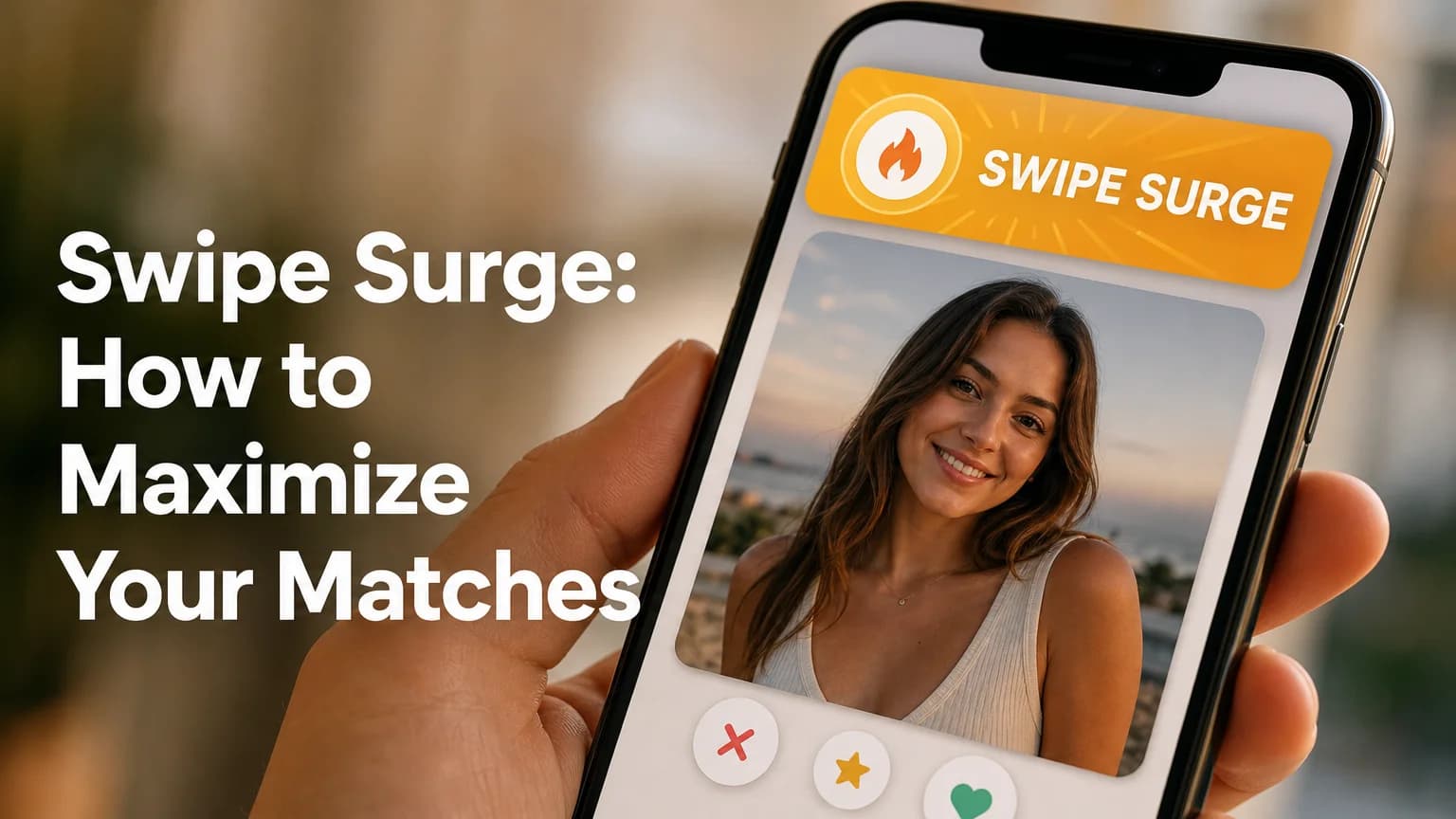
What Is Swipe Surge on Tinder? Full Breakdown
What Is Swipe Surge on Tinder? Full Breakdown
So what is swipe surge on Tinder? It's a scheduled window when Tinder detects a local spike in swiping activity and moves your profile toward the front of the stack for everyone active during that spike. Tinder's own numbers put the activity increase at up to 15x normal levels, with match potential rising as much as 250% for users swiping while it's live.
The catch nobody mentions: everyone else in your area gets the same boost at the same time, so the visibility only pays off if you're fast enough to actually reply when a match lands.
What Is Swipe Surge on Tinder?
Swipe Surge is a Tinder feature that fires when swiping activity in your area spikes and temporarily prioritizes your profile in the stack for everyone swiping during that window. Tinder's help documentation states that activity climbs up to 15x during a Surge, and match-making potential increases by up to 250% for people who opt in while it's active.
It's not a paid boost. You don't buy it, and it isn't tied to Tinder Gold or Tinder Plus. Tinder triggers it automatically based on real usage patterns in your city, and you get a push notification the moment one starts.
- Triggered by real local activity, not a scheduled promotion
- Free for every user — no subscription required to participate
- Shows up as an in-app banner and a push notification
- Puts your profile earlier in the stack for other people swiping right then
The mechanic mirrors what Uber does with surge pricing, just inverted: more demand means more upside for the people already in the pool, not a higher cost to join it.
Key Takeaways
- Swipe Surge is Tinder's feature that flags when match activity spikes in your area — typically during evenings and weekends.
- During a Surge, Tinder pushes your profile toward the front of the queue, and activity itself climbs up to 15x normal levels.
- A Surge window runs about 30 minutes and tends to repeat several times a week, so the timing is predictable once you notice the pattern.
- The visibility only converts if your profile and your replies are ready before the notification hits — unprepared guys waste the window.
- Most guys either miss the notification or freeze once the matches start coming in faster than they can think of replies; SLIDD writes the reply the second one lands, so the speed advantage doesn't go to waste.
When Swipe Surge Happens on Tinder
Tinder doesn't publish a fixed schedule, because the whole point is that a Surge tracks real local demand. That said, a pattern shows up fast once you're paying attention.
Evenings and weekends consistently produce the most Surges — Friday and Saturday nights especially, when a large share of a city's users open the app at once. Tinder has also flagged specific calendar moments, like the run-up to Valentine's Day, as reliable Surge triggers because usage spikes citywide on those dates too.
Worth knowing: Surge frequency scales with your city's population. Dense metro areas can see multiple Surges a week; smaller towns might see one every week or two.
 Tinder's Surge alert typically clusters around evening and weekend windows, when local swiping activity peaks.
If you keep the app's notifications on, you don't need to guess — Tinder tells you the second a Surge starts in your area, and the in-app banner shows how much time is left on the clock.
How Long Does Swipe Surge Last?
A Swipe Surge typically runs for about 30 minutes once it activates, based on Tinder's own in-app messaging during live windows. Surges recur multiple times a week in most cities, which makes the pattern predictable even without a published calendar.
That 30-minute window is short by design. Tinder wants a burst of concentrated activity, not an all-day promotion that dilutes the effect for everyone participating.
Two things worth planning around:
- You'll get a push notification the moment a Surge starts, with a visible countdown inside the app.
- Matches and messages during that window tend to arrive faster than normal — often within minutes instead of hours.
That second point is where most guys lose the advantage. More matches in less time is only useful if you can actually respond to them.
Does Swipe Surge on Tinder Actually Increase Matches?
Yes — Tinder's own data shows activity increasing up to 15x during a Surge and match-making potential rising by up to 250% for users who are active while it's running. Independent commentary from outlets like Wired has confirmed the mechanic: participating profiles get placed earlier in the queue, which is the actual lever behind the higher match rate.
Here's how a Surge window compares to standard swiping, side by side:
| Normal Swiping | During Swipe Surge | |
|---|---|---|
| Local activity level | Baseline | Up to 15x baseline |
| Profile queue position | Standard rotation | Prioritized, earlier placement |
| Match potential | Baseline | Up to 250% higher |
| Window length | Ongoing | ~30 minutes |
That lift is real, but it's a visibility lift, not a guaranteed-outcome lift. It puts your profile in front of more people faster — what happens after that still depends on your profile and your replies. Readers who want the underlying platform mechanics beyond Surge should check our Tinder beginner's guide for how the queue and algorithm work the rest of the time.
Using Swipe Surge to Get More Matches
A Surge amplifies whatever profile is already sitting there. If the profile is weak, you just get rejected faster in front of more people.
Before your next Surge hits, make sure these are locked in:
- A clear, recent primary photo with your face visible and well-lit
- Two to three supporting photos that show a hobby, a social setting, and one candid shot
- A bio that gives someone an actual reason to swipe, not just a job title and a height
- At least one Hinge-style prompt or bio line specific enough that a reply feels natural
If your bio still reads generic, our guide to writing a good Tinder bio breaks down tone-based examples by personality type. And if your profile as a whole needs a full pass — photo order, prompt selection, first impression — the Tinder profile help breakdown walks through what the data actually says works.
Get the profile right first: a compelling bio and a solid photo lineup do more for your match rate than the Surge itself does. The Surge just gets more eyes on it faster.
What Should You Do When Swipe Surge Is Active?
When a Surge notification hits, open the app immediately and keep swiping through the window — the boosted visibility only lasts about 30 minutes, and matches from a Surge tend to message first and fast. The real test isn't getting the match. It's what you send back before she loses interest.
 A 30-minute Surge window compresses the usual reply-time cushion — matches expect a fast response.
Here's the actual failure mode: a guy gets three matches in ten minutes during a Surge, opens the first conversation, and stares at the message box for two minutes trying to think of something that isn't "hey." By the time he sends it, she's already messaging someone else who replied faster.
This is exactly the moment SLIDD AI was built for. You switch to the SLIDD keyboard inside Tinder, tap Reply, and it reads her opening message or photo directly off your screen and writes a complete, sendable line in your chosen tone — no screenshotting, no app-switching, no sitting there blank while three other matches pile up. If she opens with "you're the first swipe surge match I've had all week," SLIDD in Witty tone might hand you: "Then I clearly showed up at the right thirty minutes." You just hit send.
Speed is the entire value of a Surge. Losing it to a slow reply defeats the point of the feature.
Get Started with SLIDD AI
Surge windows put more people in front of your profile in less time than usual — SLIDD makes sure you're not the bottleneck once they start replying. Download it before your next Surge hits so the keyboard's already there when the notifications start stacking up.
What Is Swipe Surge on Tinder Actually Worth?
Swipe Surge is worth using — it's a free, automatic visibility boost with no downside, since Tinder never charges for it and never penalizes you for skipping it. The real question isn't whether Surge works. It's whether you're set up to capitalize on it in the 30 minutes it runs.
A guy with a dialed-in profile and a fast reply habit gets genuinely more matches during a Surge than he would on a normal Tuesday afternoon. A guy who opens the app, swipes, then goes quiet for two hours gets the same matches he'd get anyway — he just burned the Surge window doing it. Solid opening lines ready to send close that gap the moment a match lands.
FAQ
What does swipe surge mean on Tinder? It's a Tinder feature that activates when local swiping activity spikes, temporarily prioritizing your profile in the queue for everyone swiping during that window. It's automatic, free, and shows up as a push notification with a countdown timer.
How do you get Swipe Surge on Tinder? You can't manually trigger it — Tinder activates a Surge automatically based on real-time activity levels in your area. Keep app notifications on so you see the alert the moment one starts, since there's no published schedule to check in advance.
Does Swipe Surge cost anything? No. Swipe Surge is a free feature built into the standard Tinder app and isn't part of Tinder Plus or Tinder Gold. Every user in an active Surge area gets the visibility boost automatically, regardless of subscription tier.
Does SLIDD work on Tinder, Hinge, and Bumble? Yes — SLIDD is a system keyboard, so it works inside every major dating app, including Tinder, Hinge, and Bumble, plus Instagram, WhatsApp, and iMessage. It reads whatever's on your screen and writes a reply in your chosen tone without you leaving the conversation.