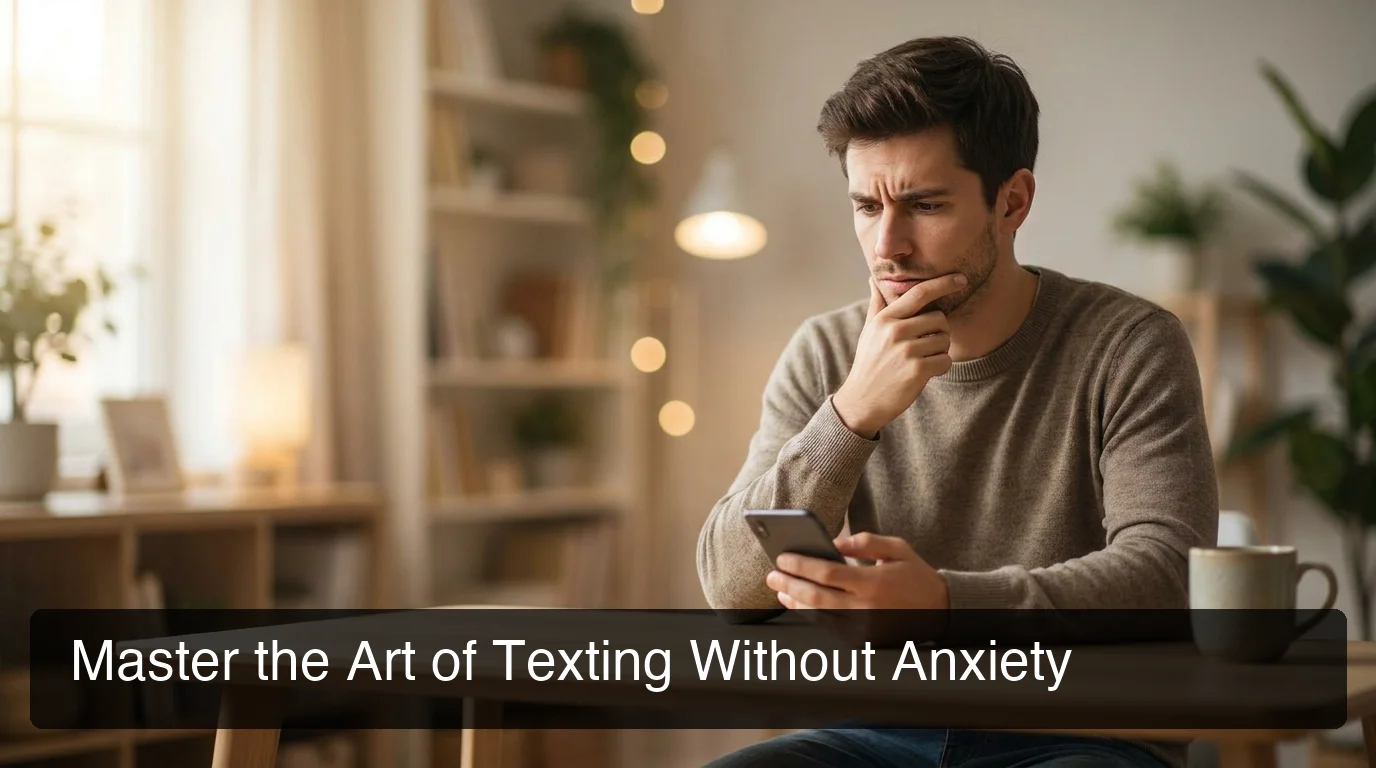
Texting Anxiety: Stop Overthinking Every Message | SLIDD
Texting Anxiety: Why You Overthink Every Message (and How to Stop)
You matched. She messaged. Now you're staring at your phone, composing and deleting the same reply for the fourth time — and you know exactly how that feels.
Key Takeaways
- Texting anxiety affects 60%+ of single men, rooted in fear of rejection and analysis paralysis — but it's a learnable pattern, not a permanent trait.
- The core issue isn't lack of ideas; it's overthinking, perfectionism, and catastrophizing normal silences as relationship-ending signals.
- Simple strategies — response time limits, authenticity over perfection, and breaking the delete-retype cycle — eliminate most texting anxiety symptoms.
- AI-powered conversation tools reduce cognitive load by handling initial message generation, letting you focus on genuine connection instead of wordsmithing.
- Texting confidence compounds: each successful exchange builds evidence that "imperfect" messages still land, breaking the anxiety cycle.
Contents
- What Is Texting Anxiety and Why Do So Many People Experience It?
- How Does Texting Anxiety Affect Your Dating Success?
- What Are the Psychological Roots of Texting Anxiety?
- What's the Difference Between Healthy Caution and Texting Anxiety?
- How Can You Overcome Texting Anxiety in 5 Practical Steps?
- Does Texting Anxiety Kill Your Rizz Before You Even Send a Message?
- How Can AI Help You Overcome Texting Anxiety?
- Frequently Asked Questions About Texting Anxiety
What Is Texting Anxiety and Why Do So Many People Experience It?
Texting anxiety is the fear, stress, or worry triggered by sending or receiving text messages — especially in romantic contexts. It affects an estimated 60%+ of single men and shows up as overthinking, delayed replies, compulsive message re-reading, and analysis paralysis over word choice, punctuation, or response timing.
 The freeze is real — but it's a cognitive pattern, not a character flaw.
It's not a clinical diagnosis, but the pattern is consistent: draft a message, read it back, decide it sounds too eager, delete it, rewrite it, send something watered-down — or don't send at all.
The problem scales with stakes. A text to a friend goes out instantly. A reply to someone you're attracted to? Every word goes under a microscope.
What Does Texting Anxiety Look Like in Practice?
- Spending 5+ minutes composing a single reply
- Rereading sent messages repeatedly, scanning for mistakes
- Feeling dread when a "read" receipt appears with no follow-up
- Analyzing her punctuation or emoji choices for hidden signals
- Procrastinating replies for hours out of fear of getting it wrong
- Abandoning conversations entirely to avoid the risk of rejection
How Does Texting Anxiety Affect Your Dating Success?
Texting anxiety destroys dating momentum by introducing friction at the moments that matter most. Conversations die not because you have nothing to say, but because the freeze between her message and your reply kills the energy she had for you — and every dead conversation is a date that never happened.
Dating apps convert matches to dates at roughly 10–15%. Texting anxiety drops that number — not because of your looks or your profile, but because of broken response loops.
When she sends a playful opener and gets a safe, overthought reply 24 hours later, the moment is gone. She's moved on emotionally, even if she hasn't unmatched.
By the numbers: Response timing matters more than message quality in early dating conversations. A mediocre reply within 5 minutes consistently outperforms a polished reply 3 hours later. Overthinking doesn't improve your texts — it just delays them while the energy drains out.
How Texting Anxiety Creates a Self-Reinforcing Spiral
One awkward exchange doesn't just hurt that conversation — it builds a story you tell yourself. Each poor outcome confirms the belief that you're a bad texter, making the next reply even harder to send. The only exit is building real evidence — through reps — that imperfect messages produce normal outcomes.
What Are the Psychological Roots of Texting Anxiety?
Texting anxiety is driven by three overlapping mechanisms: fear of rejection, perfectionism, and catastrophizing. Text messaging amplifies all three — it strips out tone, facial expressions, and body language, leaving you to evaluate a decontextualized exchange where the other person has full editorial control over interpretation.
 Texting anxiety is a learned pattern — which means it's learnable to break.
Fear of Rejection Is Amplified in Text
In person, you can course-correct in real time. A misfired joke lands differently when your expression signals it was a joke. Over text, everything is permanent and stripped of context.
You can't see her smiling as she reads it. You only see "read" with no reply.
That asymmetric vulnerability — you risk, she decides — activates the same threat response as social anxiety. It's rational, and it's trainable.
Perfectionism as Procrastination
The delete-retype cycle isn't about quality. It's about avoiding commitment to a decision. Perfectionism in texting is a procrastination mechanism dressed up as high standards.
The perfectionist spends 20 minutes crafting a reply that gets a one-word response. The guy who sends "honestly, bold choice making a hiking photo your lead — did it work?" in 30 seconds gets a coffee date.
Key insight: The best texters aren't the ones with the best lines. They're the ones who are unbothered enough to send their first idea without three rounds of editing.
Catastrophizing Silence
The most damaging texting anxiety pattern: turning a 3-hour non-reply into evidence of rejection. She's at work, she's with friends, she's at the gym.
Treating ambiguous situations as confirmed failure is cognitive distortion — and it's the engine behind most texting avoidance behavior.
What's the Difference Between Healthy Caution and Texting Anxiety?
Healthy texting caution means thinking before you send — choosing your tone intentionally, avoiding drunk texting, not flooding someone's notifications. Texting anxiety is different: it's a disproportionate fear response that makes even low-risk, neutral messages feel dangerous. The difference is whether the hesitation improves your message or just delays it.
| Behavior | Healthy Caution | Texting Anxiety |
|---|---|---|
| Re-reading before send | Once, quickly | Multiple times, obsessively |
| Response timing | Deliberate but relaxed | Agonized, overthought |
| Interpreting silence | "She's busy" | "She hates me" |
| Drafting approach | Thoughtful, direct | Rewrites, deletions, abandonment |
| Outcome mindset | "Let's see what happens" | "I'll probably blow this" |
Healthy caution improves your output. Texting anxiety degrades it — making you send a worse message than you'd have sent instinctively, or no message at all.
How Can You Overcome Texting Anxiety in 5 Practical Steps?
Overcoming texting anxiety is a behavioral process, not a mindset shift you can think your way into. The five most effective strategies address the core mechanisms — perfectionism, fear, and catastrophizing — through structured habits that build real evidence of success rather than just trying to feel more confident.
 Texting confidence is a practice, not a personality trait.
1. Set a 90-Second Response Time Limit
Give yourself 90 seconds to compose any reply. Set a timer. When it ends, send what you have.
This sounds uncomfortable — it is. That's the point: you're building evidence that quick, authentic replies work better than polished, delayed ones.
2. Edit for Truth, Not Tone
Instead of asking "how does this sound?", ask "is this what I actually want to say?" A message that sounds authentically you lands better than one that sounds clever on paper but feels performative in delivery.
For openers, pick-up lines that actually work breaks down why authentic ones consistently beat rehearsed ones — the same principle applies to every reply that follows.
3. Build a Small Starter Library
Have 5–6 reliable message patterns you know work for you. Not scripts — patterns. "Honest observation + genuine curiosity" is a pattern; "callback to something she mentioned earlier" is a pattern.
Patterns lower cognitive load without making you feel like you're reading from a list.
4. Reframe Silence as Neutral
Change your default interpretation of a non-reply. Instead of "she saw it and doesn't want to respond," default to "she hasn't replied yet." One is catastrophizing. The other is accurate.
5. Send One Imperfect Message Per Day
Make it a daily practice: send one message you'd normally agonize over, without deliberation. Track what actually happens. Over time you build an evidence base that imperfect messages produce normal outcomes — not disaster.
Bottom line: The goal isn't to become a better writer. It's to become someone who gives themselves permission to text naturally. Anxiety improves through action, not through analyzing how to act.
Does Texting Anxiety Kill Your Rizz Before You Even Send a Message?
Yes — texting anxiety is one of the primary rizz killers in digital dating. Rizz is fundamentally about calibrated confidence and natural flow. Overthinking short-circuits both.
When you're stuck in your head about every word, you can't read the conversation rhythm, respond to her energy, or write anything that sounds like it came from a real person.
The guys who read as "naturally good at texting" aren't operating on pure instinct — they've built enough reps that the overthinking layer is thin. They've sent enough imperfect texts to stop caring whether any individual one is perfect.
This is why the rizz lines and authentic openers playbook works: it's not the specific line — it's the delivery confidence behind it. If you're anxious, any line reads as try-hard. If you're grounded, almost anything works.
Anxious Texting Destroys Conversation Rhythm
She sends a playful two-word reply. You respond with a five-paragraph analysis of the topic she mentioned. She replies with another one-liner. Now you've broken the rhythm and the conversation feels like homework.
Look at how pickup lines actually work — the psychology section explains why brevity signals confidence. Short, secure replies move conversations forward. Long, careful replies signal that you were worried about the message.
 One tap. The reply appears. The freeze is gone.
How Can AI Help You Overcome Texting Anxiety?
AI-powered messaging tools reduce texting anxiety by removing the hardest part of the cognitive task: generating a starting point. When you're not staring at a blank reply field, the mental overhead drops dramatically. Most messaging anxiety isn't about what to say — it's about the gap between no message and a message.
Tools like Keys AI offer coaching support, but still require you to manually supply context via screenshot upload or copy-paste — you're solving anxiety by introducing a multi-step process around it.
How SLIDD AI Eliminates the Freeze
SLIDD AI is a keyboard extension for iOS that reads your screen in real time when you tap Reply — no screenshots, no leaving the app, no copy-paste. It sees her message, her profile, her tone, and generates a contextual reply in your chosen tone: Flirty, Bold, Witty, Sincere, or Casual.
You stay inside the conversation. The freeze is gone.
Bottom line: Using AI for texting anxiety isn't about letting an app do your dating for you. It's about eliminating the cognitive bottleneck that's preventing the real you from showing up. Once the freeze is gone, what remains is actual conversation — which is where genuine connection happens.
The confidence training-wheel effect is real: after enough SLIDD-assisted conversations, you start texting naturally and only tap Reply in genuinely stuck moments. The anxiety fades because you've built the evidence base that you needed all along.
Get Started with SLIDD AI
Texting anxiety is a cognitive pattern — and cognitive patterns change through practice. SLIDD AI gives you the reps without the paralysis: tap Reply, get the message, stay in the conversation, build the evidence that you can do this.
Not ready yet? Get the AI Dating Keyboard — start your 3-day unlimited free trial, no payment required at signup.
Frequently Asked Questions About Texting Anxiety
What is texting anxiety?
Texting anxiety is a feeling of worry, fear, or stress around sending or receiving text messages — particularly in romantic or high-stakes contexts. It's not a clinical diagnosis, but its symptoms are consistent: overthinking replies, compulsive message re-reading, analysis paralysis, and avoiding texting to escape the fear of judgment or rejection.
How do you ease texting anxiety?
The most effective approach is behavioral: set a 90-second reply timer, practice sending your first draft without re-reading it, and reframe silence as neutral rather than negative. Reducing perfectionism — not eliminating care — is the core skill. Consistent practice builds the evidence base that "imperfect" messages still land, gradually breaking the anxiety cycle.
What is the 3 text rule?
The 3 text rule is a dating heuristic: don't send more than 3 unanswered messages in a row without getting a reply. As an anxiety management tool, it gives you clear permission to stop and wait — preventing the spiral of increasingly desperate follow-up messages and the overthinking that accompanies them.
What is the 333 rule for anxiety?
The 333 rule is a grounding technique for anxiety: name 3 things you see, 3 sounds you hear, and 3 things you can physically touch. Applied to texting anxiety, it interrupts the obsessive overthinking loop by anchoring your attention to the present moment. It won't write the message, but it stops the catastrophizing spiral before it compounds.
What is SLIDD AI?
SLIDD AI is an AI keyboard for iOS that reads your screen in real time and writes dating replies for you. It works inside Hinge, Tinder, Bumble, Instagram, WhatsApp, iMessage, and any other app where you text — no screenshots, no app-switching, no copy-paste. You tap Reply on the SLIDD keyboard, it sees what's on your screen, and it generates a reply in your chosen tone (Flirty, Bold, Witty, Sincere, or Casual).
How is SLIDD different from Rizz AI or Keys AI?
Rizz AI, Keys AI, YourMove AI, and RizzGPT all require the same workflow: take a screenshot, leave the dating app, open their app, upload the screenshot, copy the reply, switch back, paste it. SLIDD eliminates every step — the keyboard is already inside the app and reads the screen in real time. SLIDD also works on Instagram Stories, WhatsApp, and iMessage, where competitors don't.
Is texting anxiety the same as social anxiety?
They share roots — both involve fear of judgment and catastrophizing — but texting anxiety is medium-specific. Many people with texting anxiety are perfectly confident face-to-face. The stripped context of text (no tone, no body language, delayed responses) creates a specific vulnerability that doesn't mirror their in-person confidence.