How to Respond to "Hey" | SLIDD
How to Respond to Hey Without Killing the Conversation
Here's how to respond to hey without the conversation stalling out: skip the mirrored "hey" back and reply with something specific — a photo, a bio line, a story she just posted — in a tone that matches the app and her energy. A generic reply reads as low effort even when that's not the intent, and it's usually the reason a promising match goes quiet after one exchange.
Enough people get stuck on this exact text that Reddit, Quora, and half a dozen dating-advice sites have entire threads dedicated to nothing but a bare "hey." That's not a coincidence — it's the single most common opener on every app, and the one guys freeze on hardest.
 A three-word text message, thirty seconds to reply, and every version of "hey back" reads the same to her.
How to Respond to Hey Without Sounding Boring?
The strongest reply to "hey" references something specific from her profile, photo, or story instead of returning the same word — paired with a tone that fits the platform, whether that's playful, direct, or low-pressure. Specificity plus tone beats length every time.
None of these require filling in a blank later — they're complete lines built around a hypothetical detail, to show the pattern:
- "Hey — that rooftop shot in your third photo is doing a lot of heavy lifting for this profile. Where was that?"
- "Hey. Your bio said you make a mean carbonara — prove it or it didn't happen."
- "Hey yourself. Marathon training on your bio is either really impressive or really terrifying, not sure which yet."
- "Hey — I need to know if that's your dog or you're just borrowing it for the photos."
- "Hey. Vinyl collection in the background of photo two — anything worth defending?"
Each one notices something real and asks a follow-up instead of stalling in small talk. That's the whole formula: specific detail, light tension, one clear next question.
Key Takeaways
- Mirroring "hey" back kills momentum — the strongest replies notice something specific instead of defaulting to small talk.
- Tone matters more than length: a sharp one-liner beats three sentences of polite, safe questions.
- Hinge, Tinder, Instagram, and iMessage each call for a different energy — the same "hey" reply doesn't perform the same everywhere.
- Picking the right tone under time pressure is the actual decision point, not finding the perfect words.
- A one-tap tone switch — Flirty, Bold, Witty, Sincere, Casual — removes the guesswork in the thirty seconds before the moment goes cold.
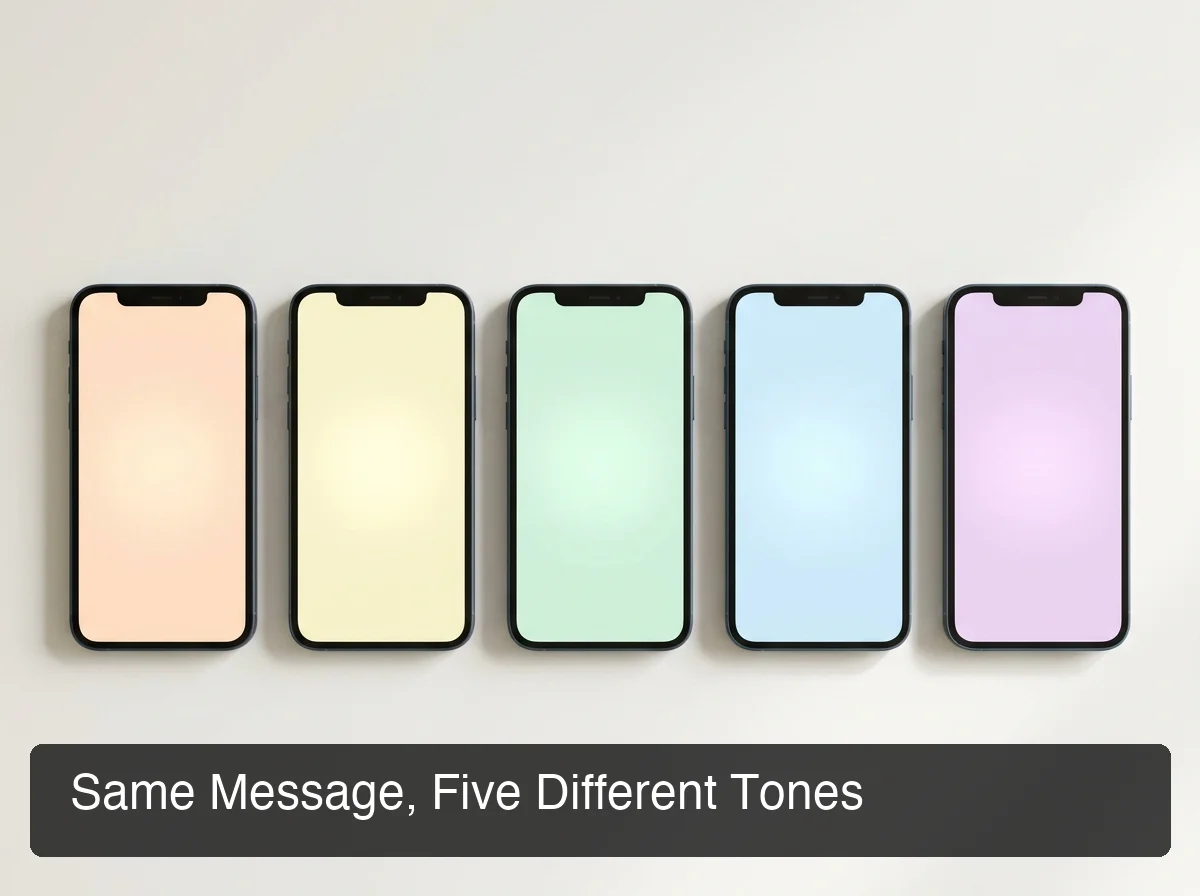 Same "hey," five completely different replies — the tone is the variable, not the wording.
The Real Problem With Hey (And Why Your Current Approach Won't Fix It)
The wording of your reply matters less than most advice admits. The real problem is that "hey" gives you zero information about which register to use, and you have to pick one in under thirty seconds while the moment is still warm.
Flirty works if she's already playful. Bold works if she wants someone to take the lead. Witty lands almost everywhere, but only when it actually lands — guess wrong and the conversation goes quiet, not because your line was bad, just because it was tuned to the wrong frequency.
This is the exact gap SLIDD's five tone presets — Flirty, Bold, Witty, Sincere, Casual — are built to close. Instead of guessing the register from scratch, you pick the tone the moment calls for, and the keyboard reads whatever's actually on your screen and writes the specific line.
Worth knowing: The freeze isn't about running out of clever things to say. It's the tone decision itself eating the thirty seconds you have before the moment goes cold.
How to Respond to Hey Differently Based on Tone?
Each SLIDD tone reframes the same "hey" into a different kind of reply: Flirty leans into tension, Bold takes the lead, Witty goes for a laugh, Sincere plays it emotionally direct, and Casual keeps things low-pressure. The right pick depends on her energy and the platform, not a fixed rule.
- Flirty — "Hey. I was going to open with something clever, but honestly I just want to know if you're always this hard to get a read on."
- Flirty — "Hey yourself — you've got about four seconds to give me a reason to keep talking to you."
- Bold — "Hey. I'm skipping the back-and-forth small talk — what are you doing Thursday?"
- Bold — "Hey. Tell me one thing about you that isn't on this profile."
- Witty — "Hey. Bold move opening with one word — I respect the confidence and the laziness equally."
- Witty — "Hey — that's the whole message? I've seen ransom notes with more effort."
- Sincere — "Hey. Long day, good day, or one of those in-between days where nothing really happened but you're still tired?"
- Sincere — "Hey — genuinely curious what's been the best part of your week so far."
- Casual — "Hey, what's going on today?"
- Casual — "Hey — anything good happen yet, or is it still one of those mornings?"
None of these are longer or more complicated than the "hey" they're replying to. Tone changes the energy of the reply, not the length of it — which is exactly why texting responses that feel effortless usually took the least amount of typing.
Why Do Some Guys Ruin Hey With One-Word Replies?
Guys torpedo a "hey" exchange by mirroring it back word-for-word, treating a low-effort opener as permission to also do the least amount of work — which reads as disinterest even when that's not the intent. The fix is committing to one tone and one specific line instead of stalling in generic mode.
A flat "hey" back, a "not much you?", a thumbs-up reaction — these all say the same thing to her: minimal effort, no read on your personality, nothing to respond to. The conversation doesn't die because the reply was rude. It dies because there was nothing in it to react to.
If the one-word habit shows up again a few messages later, it's usually a pattern rather than a one-off. Our how to keep a conversation going guide covers the momentum problem that starts right here and keeps resurfacing past the first reply.
Common mistake: Treating "hey" as low-stakes because it's short. It's actually the highest-leverage message in the whole exchange — it sets the tone for everything that follows.
Do Hinge, Tinder, and Instagram Need Different Hey Replies?
Yes — the same line doesn't perform the same on every platform, because each one sets a different expectation for pace and tone. Hinge rewards specificity, Tinder rewards directness, and Instagram rewards reacting to something she just posted.
| Platform | Typical Energy | Example "Hey" Reply |
|---|---|---|
| Hinge | Specific, prompt-based | "Hey — your prompt about your worst travel story needs a follow-up. What happened?" |
| Tinder | Fast, confident | "Hey. Skip the warm-up — coffee or drinks, pick one." |
| Instagram DMs/Stories | Reactive, in-the-moment | "Hey — that story from the concert looked chaotic in the best way. Who dragged you there?" |
| WhatsApp/iMessage | Familiar, low-pressure | "Hey, made it home okay?" |
Hinge basically writes the setup for you through her prompts — our best Hinge openers breakdown covers that pattern in more depth. Tinder rewards a faster, more confident opener with less context to work from, which is the exact gap our best Tinder openers piece is built around.
Both sit inside a broader idea worth understanding once: the opening lines on dating apps framework that explains why the same words land differently depending on where they're sent. When she posts a story instead of texting directly, the response rules change again — a story reply lives by a different clock than a DM ever does.
 The message is already sitting there. The tone you pick is the only decision left.
Get Started with SLIDD
Picking the right tone for a bare "hey" is the whole game, and doing it inside the thirty seconds before the moment goes cold is the actual hard part. SLIDD reads whatever's on your screen and writes that specific reply in Flirty, Bold, Witty, Sincere, or Casual — one tap, no screenshotting required.
FAQ
What's the safest thing to text back after "hey"? There's no universally safe reply — anything generic reads as low effort. The strongest response references something specific, like a photo, bio detail, or story, and picks a tone that matches the moment instead of sending another flat "hey" back.
Is it flirty to just text someone "hey"? On its own, "hey" isn't inherently flirty — it's neutral by design, which is why it works as a low-risk opener on every platform. The flirtiness comes from what follows: the tone, the timing, and whether the next message builds tension or stays flat.
Does SLIDD work on Hinge, Tinder, and Instagram? Yes. SLIDD works across every major dating and messaging app on iOS, including Hinge, Tinder, Bumble, Instagram DMs and Stories, Snapchat, WhatsApp, and iMessage. It's a system keyboard rather than a standalone app, so it reads whatever's on-screen no matter which app is open.
Is SLIDD free to try before committing? New signups get three full days of unlimited access — every tone, unlimited replies, no payment required upfront, with the trial clock starting the moment the account is created. After that, plans run $6.99 a week, $19.99 a month, or $99.99 a year for full unlimited access.