Difference Between Tinder Hinge and Bumble (2026)
Difference Between Tinder Hinge and Bumble: How Each App Changes Your Reply
Three apps, one match, three completely different first messages. The difference between Tinder Hinge and Bumble is not the logo or the price. It is the structure: who is allowed to speak first, and what you have to react to when you do.
| Tinder | Hinge | Bumble | |
|---|---|---|---|
| Who can send the first message | Either person | Either person | The woman, in a man-woman match |
| What you react to | Photos, a short bio | Photos plus written prompts | Photos, bio, and any prompt she set |
| Pace of the chat | Fast, high volume | Slower, one-thread-at-a-time feel | Time-boxed; matches can expire |
| Best opening move | Short, playful, specific | A reply to one exact prompt | Answer her opening question |
App rules change with updates, so treat the table as a snapshot and check the app itself before you plan around a detail.
Key Takeaways
- Tinder rewards quick, volume-driven openers; Hinge rewards specific replies to a prompt; Bumble puts the woman in charge of the first message.
- There is no single best line. The best reply depends on the app's structure and on what she gave you to work with.
- SLIDD AI is a native iOS keyboard, so the same reply tool works inside Tinder, Hinge, and Bumble (iOS only, US and Canada, 18+).
What Is the Real Difference Between Tinder Hinge and Bumble?
Tinder is a swipe-first app where either person can message after a match. Hinge is built around written prompts, so conversations start from something specific. Bumble keeps the same match mechanic but, in man-woman matches, lets the woman send the first message.
Those three rules sound like trivia until you are the one typing. They decide how much material you have, how much time you have, and who is carrying the pressure.
On Tinder you often get a few photos and a short bio. That is thin, so the reply has to be quick and light. On Hinge you get prompts, which hand you a built-in topic. On Bumble, if she writes first, your job is to answer well rather than open well.
The structure behind each app
- Tinder: swipe, match, then either person can speak. Volume is high and attention is short.
- Hinge: you like a specific photo or prompt and can attach a comment. The first message is therefore already half-written by the profile.
- Bumble: the match is the same, but the first-message rule is not. In a man-woman match she moves first, and unanswered matches can lapse.
Reality check: a line that works on one app can flop on another because the setup is different, not because the line is bad.
Which App Gets the Most Replies, and Why?
No app guarantees replies, and nobody outside these companies has clean public reply-rate data for all three. What changes the odds is how specific your first message is to the profile in front of you, on any of the apps.
So be suspicious of any article that hands you a neat percentage per app. The honest pattern is simpler: a generic "hey" gets treated as a generic "hey" everywhere.
Here is how that plays out in practice, with lines you can send as written.
On Tinder, she has a photo of a golden retriever at a lake and a one-line bio:
- "Your dog looks like he's never lost an argument. Does he get that from you?"
- "That lake photo is suspiciously good. Is the dog the photographer?"
On Hinge, her prompt says "The way to win me over is... a really good playlist":
- "Challenge accepted. First track is a 2am drive song. Your turn to tell me if I pass."
- "Dangerous prompt. I'm going to need your top three before I show my hand."
On Bumble, she opens with "If you could be anywhere right now, where would you be?":
- "Honestly, a night market in Osaka. You?"
- "Anywhere with a patio and a long dinner. Pick the city and I'll pick the restaurant."
What this means for you: Tinder gives you a photo to riff on, Hinge gives you a sentence to answer, and Bumble gives you a question to return.
How Does Each App Change the Way You Open and Reply?
Each app changes the job. On Tinder you open with something short that earns a reply. On Hinge you respond to the exact prompt she wrote. On Bumble you usually reply to her opener and keep the thread moving before the match runs out.
Tinder: short and specific
Tinder punishes long messages and rewards a clear hook. Keep it to one or two lines and point at a detail she chose to show. If you want more examples, tinder tips for men covers bios, openers, and replies for this app.
Hinge: answer the prompt, not the person
Hinge tells you what she wants to talk about. Answer the prompt itself and add one question. Two guides go deeper on this: Hinge replies for mid-conversation messages, and best Hinge openers for the first line. If you only want the basics, Hinge opener is the shortest path.
Bumble: reply fast to a first move you did not choose
On Bumble the thread usually starts with her message, so your reply sets the tone. Match her energy and give her something easy to answer. The full breakdown is in Bumble first message.
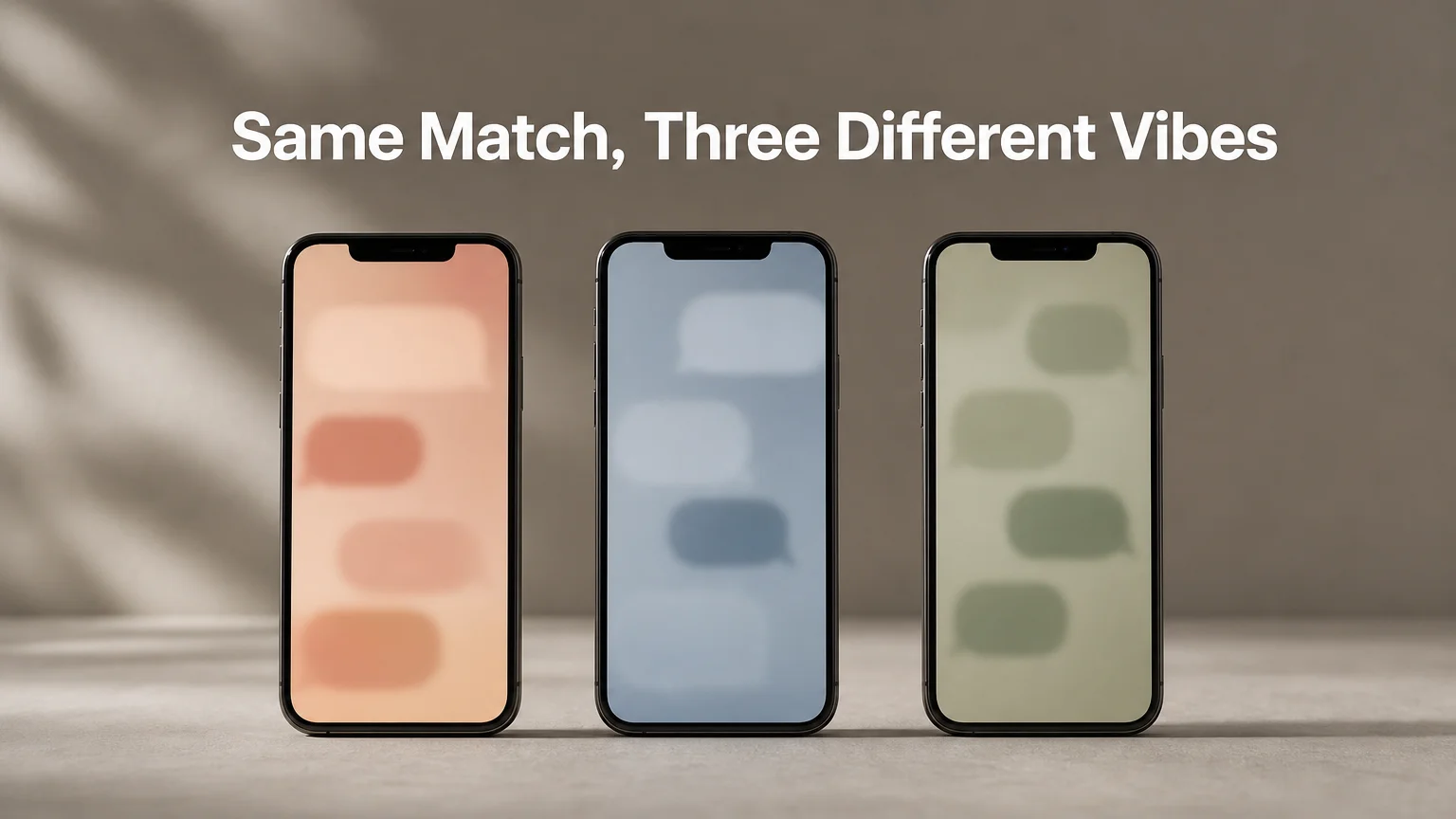 Same match, three structures: the reply that fits one app can miss on the other two.
The One-Tap Fix: Replies That Work in All Three Apps
SLIDD AI is an iOS keyboard, so it is not tied to one dating app. You switch to it inside Tinder, Hinge, or Bumble, tap Reply, and it reads the screen where the conversation is and writes a reply in the tone you pick.
That matters here because the three apps need three different kinds of reply. A keyboard that reads the screen sees her photo on Tinder, her prompt on Hinge, and her opening question on Bumble, and writes for what is actually in front of it. Hinge, Tinder, and Bumble are all on the list of apps SLIDD is tested and tuned for.
The flow is the same everywhere:
- Open the conversation in the app and tap the text field.
- Switch to the SLIDD keyboard.
- Tap Reply, pick a tone such as Witty or Casual, and send the result.
There are no screenshots and no copy-paste, and you never leave the app. If you want proof for one of the three, does SLIDD AI work on Tinder walks through it. SLIDD is iOS only for now, live in the US and Canada, and the App Store rating is 18+.
Worth knowing: because SLIDD is a system keyboard, there is no per-app integration to break when Tinder, Hinge, or Bumble updates its design. The claim is availability in all three apps, not identical output in each.
What Is the Difference Between Tinder Hinge and Bumble for Serious Dating?
Hinge is usually the strongest fit for serious dating because its prompts surface personality and intent. Bumble suits people who want a more structured, deliberate start. Tinder works for serious dating too, but it takes more filtering because it is the broadest and fastest of the three.
That is a judgment call from how the apps are built, not a measured result. Hinge's written prompts make it easier to tell whether you are on the same page before the first message. Bumble's first-message rule filters for people willing to commit to starting a chat.
Tinder's strength is size and speed, and its weakness is the same thing. You see more people, but you also see more profiles that say very little.
 Pick the app for the goal, then write for that app's rules.
A simple way to choose
- Want volume and speed? Tinder.
- Want conversations that start from something real? Hinge.
- Want a calmer, more structured start? Bumble.
Many people run two at once. That is where a reply tool that follows you across apps saves the most effort.
Get Started With SLIDD AI
If the apps differ and your reply has to change with them, it helps to have one keyboard that adapts instead of three separate habits. SLIDD AI starts with a 3-day unlimited free trial, and no payment is required at signup.
FAQ
Which is better, Tinder, Hinge, or Bumble?
None is better in every case. Tinder suits speed and volume, Hinge suits prompt-led conversations and serious dating, and Bumble suits a more structured start where the woman messages first. Pick the app that matches your goal, then write replies that fit its rules.
Is Hinge better than Tinder for serious dating?
Hinge is generally the better fit, because its prompts show personality and intent before anyone says a word. That gives you more to respond to and makes the first message more specific. Tinder can still lead to relationships, but it needs more filtering.
Does SLIDD work on Tinder, Hinge, and Bumble?
Yes. SLIDD AI is a native iOS keyboard, so it works inside Tinder, Hinge, and Bumble rather than through a separate integration for each. You tap Reply on the keyboard and it reads the screen. It is iOS only and live in the US and Canada.
Is SLIDD AI free to try?
New users get a 3-day unlimited free trial with every tone and no payment at signup. After that, plans are $6.99 per week, $19.99 per month, or $99.99 per year, each unlocking unlimited replies and the custom tone builder.